
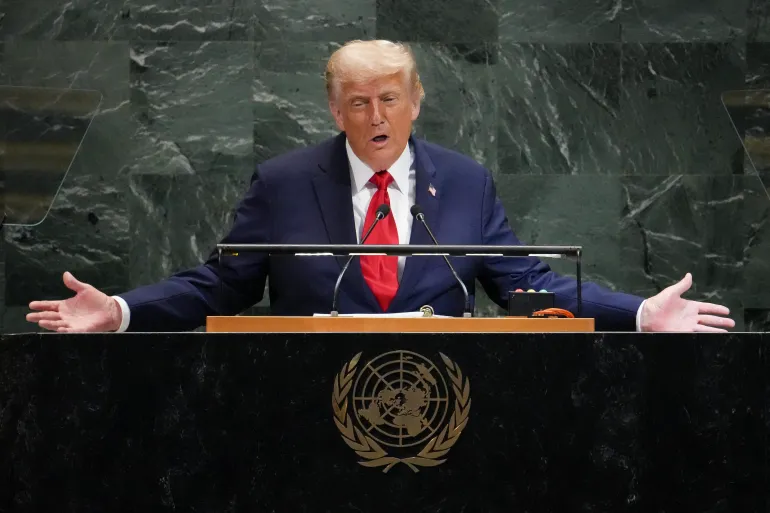
President Donald Trump grabbed headlines at the United Nations General Assembly on September 23, 2025, by unveiling a comprehensive 21-point peace proposal aimed squarely at resolving the Gaza conflict and fostering broader Middle East stability.
On the sidelines of the UNGA in New York, he convened a high-stakes meeting with leaders from key Muslim-majority nations, including Saudi Arabia, Qatar, Egypt, Turkey, the United Arab Emirates, Pakistan, and Jordan. There, he presented the plan in detail, signaling a renewed U.S. commitment to the region after years of strained relations.
The Trump 21-point plan for peace in the Middle East and Gaza
Trump’s envoy, Steve Witkoff, confirmed the rollout during a briefing on September 24, 2025, at the Concordia summit. “We presented what we call the Trump 21-point plan for peace in the Middle East and Gaza,” Witkoff declared, adding that the discussions proved “extremely productive” and addressed “all concerns” from the attending leaders. Furthermore, the proposal builds on ideas floated over the past six months, incorporating elements from Trump’s son-in-law Jared Kushner and former British Prime Minister Tony Blair. For instance, it explicitly pledges to block any Israeli annexation of the West Bank—a move that has long frustrated Arab states and threatened the fragile two-state solution.
Egyptian President Abdel Fattah el-Sisi praised the initiative publicly, calling it “an important foundation” for future peace efforts. Similarly, other regional powers expressed support, viewing the plan as a potential pathway to end the nearly two-year Gaza war and provide post-Hamas governance options. Yet, challenges loom large. Analysts note that success hinges on Iran’s cooperation and Israel’s willingness to curb military operations, especially after recent airstrikes disrupted indirect talks between Hamas and Israel. Additionally, Trump’s UNGA speech on September 23 blasted the U.N. for past inaction while urging an “immediate” end to the Gaza fighting and condemning recent Western recognitions of Palestinian statehood as rewards for Hamas.
In essence, this 21-point blueprint marks a pivotal shift. Trump positions it as a “win-win” for all parties, emphasizing civilian relief, hostage releases, and economic rebuilding in Gaza. Consequently, as Netanyahu prepares to address the UNGA on September 26, 2025, the world watches closely. If momentum builds, this could redefine U.S. diplomacy in the Middle East; otherwise, it risks becoming another stalled accord.
Leave a Reply