
Astronomers studying the distant reaches of our galaxy have detected dramatic changes in one of the universe’s largest known stars, surprising researchers and shedding new light on how massive stars evolve before they die.
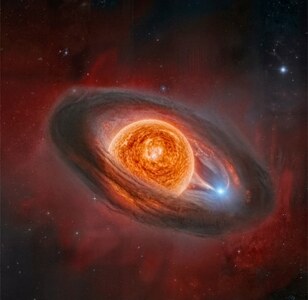
The star in question, designated NML Cygni, is a red hypergiant—one of the largest and most luminous stars ever recorded. It sits about 5,200 light-years from Earth in the constellation Cygnus and has a radius roughly 1,650 times larger than the Sun, meaning if placed at the center of our solar system, its surface would extend beyond the orbit of Jupiter.
Using data from international telescopes and space observatories, scientists noticed significant and unexpected variations in the star’s brightness and outer layers. The findings suggest that NML Cygni may be undergoing dramatic changes as it nears the end of its life cycle—possibly shedding massive amounts of stellar material. This behaviour could be linked to complex internal processes that precede a supernova explosion.
Researchers say studying such massive stars is key to understanding cosmic evolution, including how they enrich space with heavy elements and influence surrounding celestial environments. Future observations are planned to track NML Cygni’s activity and refine models of massive stellar death.
Leave a Reply