
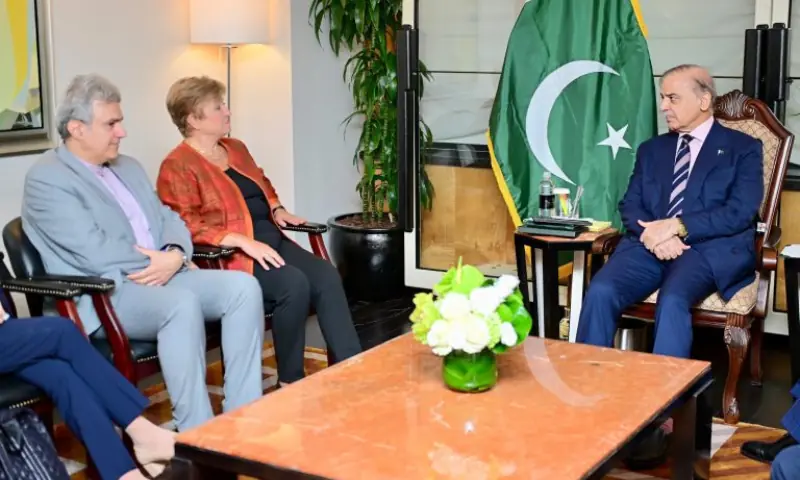
On September 24, 2025, during the 80th United Nations General Assembly in New York, Prime Minister Shehbaz Sharif met IMF Managing Director Kristalina Georgieva. He firmly urged the global lender to incorporate the severe impacts of recent floods into the next review of Pakistan’s bailout program.
Sharif confidently highlighted Pakistan’s progress first. For instance, the country steadily advances toward meeting targets under the $7 billion Extended Fund Facility (EFF), which follows a $3 billion Stand-By Arrangement in 2024 and a $1.4 billion Resilience and Sustainability Facility. Moreover, deep-rooted structural reforms now drive positive signs of stabilization. As Sharif noted, “Pakistan’s economy shows positive signs of stabilization and is now moving towards recovery.” Consequently, he appreciates the IMF’s longstanding partnership, especially under Georgieva’s leadership, which guides these efforts effectively.
However, the floods demand immediate attention. Massive monsoon rains since late June, worsened by dam releases from India, have submerged key provinces like Punjab and Sindh. Over 1,000 people have lost their lives, and more than 2.5 million others face evacuation. Additionally, billions in damages threaten food supplies, exports, and fragile growth. Therefore, Sharif emphasized that “the impact of the recent floods on Pakistan’s economy must be factored into the IMF’s review.” In response, Georgieva expressed sympathy and commended Sharif’s macroeconomic policies. She also reiterated the IMF’s support for sustainable reforms, while stressing the need for damage assessments to shape recovery priorities.
Beyond the IMF talks, Sharif extends his outreach. For example, he met World Bank President Ajay Banga to discuss reforms in resource mobilization, energy, privatization, and climate resilience. Furthermore, an IMF mission arrives in Islamabad on September 25 for the second review, potentially unlocking a $1 billion tranche. Meanwhile, Sharif suspends August electricity bill collections in flood-hit areas and seeks IMF waivers for broader relief.
By weaving flood realities into international dialogues, he positions the nation for equitable support.
Leave a Reply