
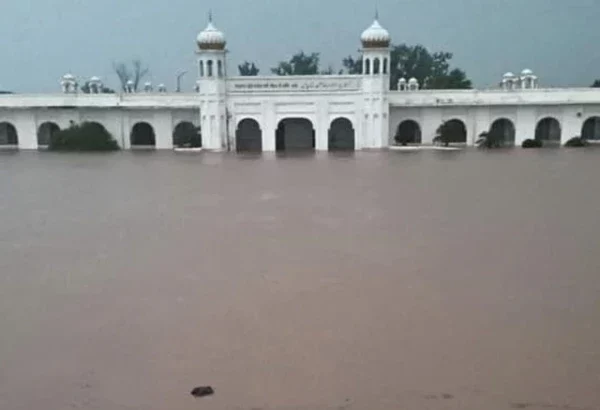
Heavy rainfall and the release of excess water from dams in India have triggered severe flooding at Gurdwara Darbar Sahib in Kartarpur, Pakistan, a sacred Sikh pilgrimage site. On August 27, 2025, floodwaters from the swollen Ravi River inundated the historic shrine, submerging parts of the complex and the Kartarpur Corridor, which connects the gurdwara to Dera Baba Nanak in India. This natural disaster has disrupted religious activities, stranded over 100 people, and sparked widespread concern among the global Sikh community.
Flooding Disrupts Sacred Site
The Gurdwara Darbar Sahib, revered as the final resting place of Guru Nanak Dev, the founder of Sikhism, now stands surrounded by 5 to 7 feet of floodwater. Visuals circulating on social media show the shrine’s courtyard and sanctum partially submerged, with water levels reaching up to four steps of the staircase inside the main complex. The flooding stems from heavy monsoon rains in Pakistan and the release of water from India’s Ranjit Sagar, Pong, and Bhakra dams, which caused the Ravi River to breach its embankments. A protective dam near Bheko Chak collapsed, exacerbating the crisis and flooding nearby villages, farmland, and the Narowal–Shakargarh road.
Pakistani authorities have launched rescue operations, evacuating over 200,000 people across Punjab province. At Gurdwara Kartarpur Sahib, the sacred Saroop of Guru Granth Sahib and sevadars (caretakers) have been safely moved to the first floor. Helicopters and boats are on standby to evacuate stranded staff if water levels rise further. The Kartarpur Corridor, a 4-km visa-free passage for Indian pilgrims, has remained closed since April 2025 due to unrelated security concerns, but the flooding has now rendered it inoperable, raising fears of damage to this symbolic infrastructure.
Regional Impact and Response
The flooding extends beyond Kartarpur, affecting multiple districts in Pakistan’s Punjab province, including Narowal, Sialkot, and Bahawalnagar. The Ravi River at Jassar is carrying a high flood of 202,200 cusecs, with projections of reaching 229,700 cusecs, threatening low-lying areas like Shahdara and Lahore. Pakistan’s National Disaster Management Authority (NDMA) has issued a red alert, urging residents to avoid riverbanks and low-lying areas. Prime Minister Shehbaz Sharif has directed authorities to enhance early warning systems and coordinate relief efforts, with the Pakistan Army assisting in rescue operations.
On the Indian side, Punjab’s Gurdaspur district faces similar challenges. A breach in the Dhussi embankment has submerged villages near Dera Baba Nanak, flooding thousands of acres of farmland. Punjab Chief Minister Bhagwant Mann has closed schools until August 30, 2025, and established a central flood control room in Jalandhar to manage the crisis. India alerted Pakistan about potential cross-border flooding, marking a rare diplomatic communication amid strained relations following the Pahalgam attack in Jammu and Kashmir.
The Meteorological Department warns of more rainfall in the coming days, raising fears of worsening floods. The Ravi, Sutlej, and Chenab rivers remain at dangerously high levels, with the Ravi at Kot Nain flowing at 155,000 cusecs—exceeding its capacity of 150,000 cusecs. Pakistani officials are monitoring river levels closely, but the collapse of protective embankments has complicated relief efforts. The Sikh community and local residents have urged both governments and global organizations to prioritize the protection of Kartarpur Sahib and support affected communities.
Leave a Reply