
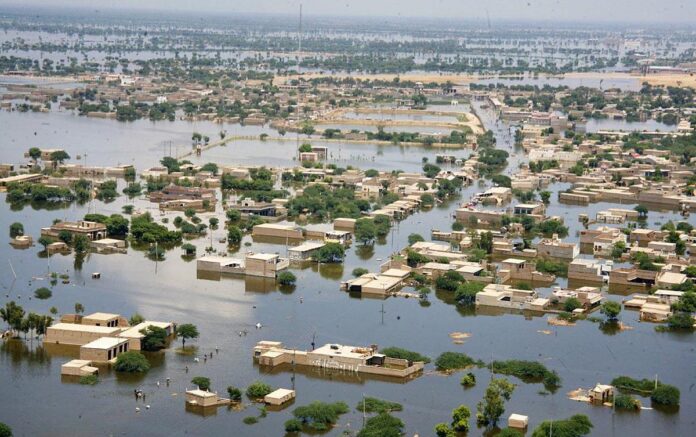
More than 1,400 villages and thousands of square kilometers of land in Pakistan have submerged since June 2025, claiming over 800 lives and displacing more than 1 million people. At least 993 individuals have suffered injuries, with thousands of acres of crops devastated and over 1,000 livestock lost. More than 4,000 homes have collapsed, shattering livelihoods irreparably. Yet, the causes remain tangled in a complex blame game, with fingers pointing towards India’s dam releases, climate change, and the country’s own vulnerabilities—but where does responsibility truly lie?
India’s Role
Pakistan frequently blames India for worsening the 2025 floods, with officials like Defence Minister Khawaja Muhammad Asif and former envoy Abdul Basit pointing to water releases from dams like the Thein (Ranjit Sagar) Dam on the Ravi River and the damaged Madhopur barrage. Asif claimed floodwaters from India carried “debris and livestock” into Sialkot, impacting 1,200 hectares of crops and 35,000 residents, while Basit accused India of “weaponizing” water after suspending the Indus Waters Treaty (IWT) in April 2025. India’s role, shrouded in a mystery of deliberation and unintentional impact, has an indelible impact on the crisis.
Upstream Dam Releases
India controls the Ravi, Sutlej, and Chenab rivers, which flooded 1,404 villages across Punjab’s Narowal, Sialkot, and Lahore districts. On August 27, 2025, two collapsed gates at the Madhopur barrage unleashed 300,000 cusecs of water into Pakistan. Coupled with heavy monsoon rains, averaging 200mm daily in India’s Punjab, led India to release 1.2 million cusecs from Thein Dam to prevent breaches, which amplified downstream flooding.
IWT Suspension
Moreover, India’s suspension of the IWT, following a Kashmir conflict, disrupted real-time data sharing, limiting Pakistan’s flood forecasting. Only four informal alerts, sent since August 14, 2025, reached Pakistan, compared to the IWT’s mandated 24-hour updates. This delay affected 150,000 forced evacuations in Punjab, with Pakistan’s NDMA struggling to respond.
Climate-Change
While India’s water releases were a proximate trigger, climate change looms large as a deeper driver of the 2025 floods. Studies, including one by the World Weather Attribution group, found that human-caused climate change intensified monsoon rainfall by 10–15% from June 24 to July 23, contributing to building collapses and widespread devastation. The monsoon season brought record-breaking rains, with Punjab and other regions seeing torrents described as a “one in 100-year event.” In northern Pakistan, accelerated glacial melting in Gilgit-Baltistan and Khyber Pakhtunkhwa, driven by rising temperatures, swelled rivers like the Indus, adding to the deluge.
Despite contributing less than 1% to global greenhouse gas emissions, it ranks among the top 10 most climate-vulnerable nations, according to the Germanwatch Climate Risk Index. The 2022 floods, which submerged a third of the country and killed over 1,700, were a grim precursor, with climate change estimated to have made rainfall up to 50% more intense. In 2025, the pattern repeated: erratic monsoons, intensified by a warmer atmosphere holding more moisture, overwhelmed Pakistan’s rivers and drainage systems. Cloudbursts—intense, localized rain events—further battered regions like Khyber Pakhtunkhwa, killing over 370 in Buner district alone.
Pakistan’s Internal Vulnerabilities
While external factors dominate the narrative, Pakistan’s internal shortcomings amplify the floods’ impact. Decades of poor infrastructure, deforestation, and inadequate urban planning have left the country ill-equipped to handle extreme weather.
Urban System Failure
In urban centers like Karachi and Sialkot, blocked sewers and outdated drainage systems exacerbate flooding. Karachi’s drainage issues, compounded by illegal construction, paralyzed the city in 2025, with officials declaring a public holiday to manage the chaos. In Sialkot, a $250 million Asian Development Bank project to upgrade sewage systems has yet to resolve persistent issues, leaving stagnant floodwaters mixed with sewage to breed diseases like malaria and cholera.
Rural Challenges
Rural areas fare no better. Pakistan’s reliance on outdated irrigation methods and insufficient water storage—only 9% of annual inflow compared to a global average of 40%—means it cannot manage floodwaters or store surplus for droughts. Deforestation and mangrove loss have eroded natural flood barriers, while flimsy homes in floodplains collapse under heavy rains. The National Disaster Management Authority (NDMA) reported 1,600 homes damaged in 2025, with 30% of monsoon deaths linked to collapsing structures.
Governance Gaps
Governance issues further muddy the waters. The Ministry of Climate Change’s budget was slashed to $9.7 million in 2025, dwarfed by a $9 billion defense budget, signaling misplaced priorities. Early warning systems, while present, failed in places like Buner, where residents received no alerts before flash floods struck, killing over 228. The NDMA’s efforts, including forced evacuations and army-led rescues, have been reactive, not preventive.
Beyond the Blame
The 2025 floods reveal a complex web of responsibility, with each actor deflecting blame. Pakistan points to India’s water releases, but India counters with the necessity of dam safety and its own monsoon struggles. Both nations acknowledge climate change, yet Pakistan’s minimal emissions contrast with its outsized suffering, shifting blame to global polluters. Meanwhile, Pakistan’s internal failures—poor infrastructure, governance, and preparedness—undermine its resilience, though it argues that resource constraints, worsened by global inequities, limit its capacity to adapt.
This blame game obscures solutions. Restoring the Indus Waters Treaty could ensure better data sharing, mitigating cross-border flooding risks. Global climate funds must scale up to support vulnerable nations like Pakistan, which cannot bear the cost of adaptation alone. Locally, Pakistan needs to prioritize climate-resilient infrastructure, from modern drainage systems to flood-resistant housing, and invest in early warning systems that reach remote areas.
Leave a Reply