
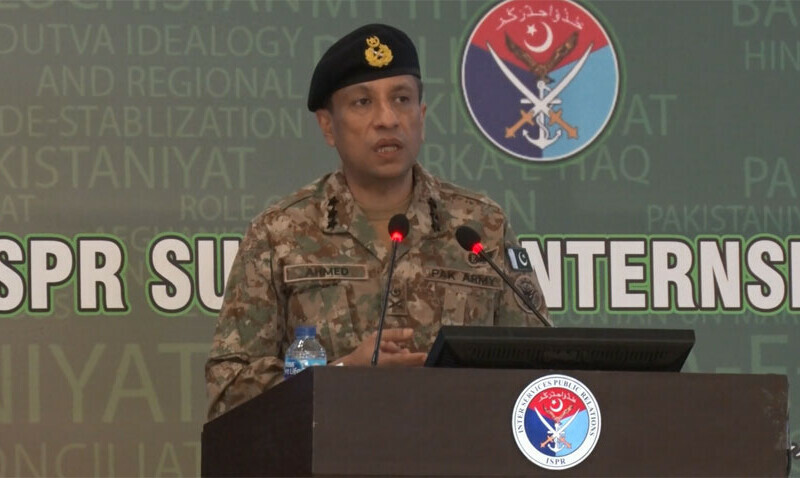
Director General Inter-Services Public Relations (DG ISPR) Lt. Gen. Ahmed Sharif Chaudhry addressed misconceptions about Balochistan today, asserting that the province’s people and youth share a deep bond with Pakistan. Speaking at an interactive session with students during the ISPR internship program in Quetta, he tackled questions from Baloch participants, emphasizing their integral role in the nation’s fabric.
Balochistan Stands United With Pakistan
Lt. Gen. Chaudhry paid tribute to Major Muhammad Anwar Kakar Shaheed, a heroic officer from Balochistan who neutralized several terrorists during the Gwadar attack. “He was a proud son of the soil,” the DG ISPR said, highlighting the province’s bravery and sacrifices. He stressed that Pakistan’s independence relies on the daily contributions of soldiers, officers, and civilians, particularly in Balochistan, where locals actively identify terrorists to support military efforts.
The DG ISPR explained that intelligence-based operations succeed only when communities expose terrorist networks. “The Army cannot clear an area and leave; terrorists will return,” he said. “That’s why we rely on the people’s cooperation.” He warned that individuals sheltering terrorists or storing explosives face consequences but clarified that collective punishment of entire villages or tribes is unjust and avoided.
Balochistan’s citizens, he noted, are increasingly vocal against terrorism, pointing out hideouts and facilitators out of exhaustion with violence. “The Baloch are wise, farsighted, and determined,” Lt. Gen. Chaudhry said. “Many educated Baloch now shape their own destinies.” He cited examples of progress, including scientist Samad Yar Jung, a Blida School alumnus who studied at Cambridge, and sportsman Shahzaib Rind, who has brought pride to the province. Baloch women, he added, now serve as deputy commissioners, showcasing the community’s advancement.
Reaffirming Pakistan’s inclusive foundation, Lt. Gen. Chaudhry quoted the Prophet Muhammad (PBUH): “No Arab has superiority over a non-Arab, nor a white over a black.” He emphasized that Pakistan unites beyond ethnic or regional divides, rooted in the Kalima.
Leave a Reply